

MSI Afterburner

- The best GPU benchmarking softwarernBuilt for GPUs
The time-honored measuring stick of “Can It Run Crysis?” doesn’t carry importance anymore.
Numerous applications have been developed to provide a more precise way of testing the newest GPUs, but there are different ways to perform these tests and many more types of GPU benchmarking software available.
This guide will show you a comprehensive look at a few of these applications and help you find the ideal GPU benchmarking software for 2025.
First, you should know why we’re even using benchmarking software and why it’s crucial to know which is the top. There are various reasons why you might want to benchmark your GPU, but the most common one is to know how much intensity your graphics card can handle.
You could be looking for bottleneck issues in your machine, or maybe you just want to test your state-of-the-art GPU and compare it with other users. It could also be that you’re overclocking your card and wondering just how near to the limit you have managed to push it.
We also need to discuss the various methods of benchmarking. On the surface, this may seem like a basic stress test, but if we dig a little deeper, there are clearly two distinct ways of benchmarking your graphics card.
Synthetic Benchmarks are programs designed to replicate the characteristics of a significant set of software. For this reason, they’re also called Simulated Benchmarks.
The aim is to create a single benchmark program where the execution frequency of statements in the benchmark matches the statement frequency of a comprehensive set of benchmarks. The outcomes will usually be presented as a score/points, but this doesn’t tell gamers what they really want to know: their frame rate.
Real-time benchmarking provides exactly that. This type of benchmarking is also called Real-world benchmarking, as it can be used to test specific games and provide accurate FPS, which is why gamers opt for this sort of test in the first place.
Keep in mind that, even when employing both benchmarking methods, you might still have an awful frame rate despite possessing a high-end graphics card. This is likely the consequence of a bottleneck elsewhere, such as your CPU or RAM.
Let’s examine the top GPU benchmarking software currently available.
Table of ContentsShow
3DMark
This is probably the main result of almost any benchmarking-related software search. It was produced by a software company, Futuremark, which develops various benchmarking tools for commercial and residential use.

Something cool about 3DMark is that there is a complimentary version available. If you plan on using a benchmarking tool regularly, however, it’s probably worth trying the Advanced Edition. You should also use the Advanced Edition if you’re looking to test for 4K settings, as that preset is only accessible there. There is also a Professional Edition, which is designed for commercial use.
3DMark displays detailed charts for thermal levels (both CPU and GPU) and shows how speed and framerate change during testing. The finest part of this software is that it recognizes the hardware you own and assigns a suitable benchmark test.
It is also available for Android and iOS platforms, which is another substantial advantage.
PassMark PerformanceTest
PassMark is fast and simple to use, which is a excellent benchmark for any software (pun intended). PerformanceTest can benchmark your CPU, 2D/3D graphics, Memory, Storage, and CD drive via 28 standard benchmark tests across six suites. A detail that many tech enthusiasts will appreciate is the ability to create their own customized tests.

The largest drawback of PerformanceTest is that while it technically comes in two versions, free and paid, the complimentary one barely resembles the full edition. It’s essentially worthless.
However, the paid version of PassMark is considered one of the finest benchmarking tools because it is exceptionally thorough and extensive.
Heaven UNIGINE
This is a very challenging GPU benchmarking tool. The fact that it is primarily a GPU benchmarking software is what separates it from the others. It is designed to perform very comprehensive and prolonged stress tests for the graphics card and can be used to measure its stability accurately.
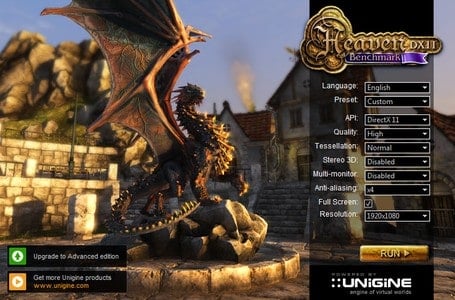
Another reason why this might be the best tool for overclockers is the ability to monitor the GPU cooler and see how much it can handle when pushed to the absolute extreme.
FurMark
FurMark is a GPU benchmarking software for cards that are OpenGL compatible (this applies to the vast majority of GPUs, so don’t worry). This tool can also be used to monitor the temperature. As such, it’s beneficial when overclocking.
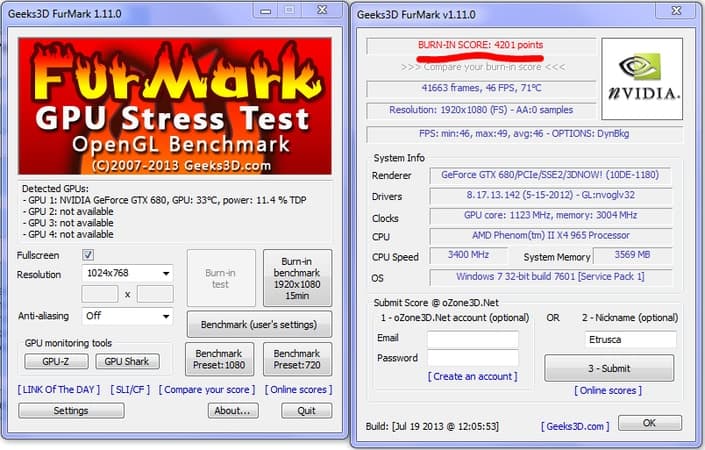
Although FurMark (also known as GPU Burner) is complimentary, it’s only available on Windows platforms. Still, this software is beneficial enough to be among the most popular benchmarking apps out there.
GFXBench
Your initial impression might be that this is just another free GPU benchmarking software, but it’s far more than that. Unfortunately, the stigma against ‘free software’ still persists, but GFXBench is doing its best to combat it.
It’s an excellent tool with tests made especially for various purposes. The finest aspect is that you can compare your graphics card’s performance with almost any other.

As demonstrated, GFXBench allows testing on multiple platforms and comparing performance to additional systems.
Superposition
Coming to you from the makers of Heaven, Superposition is another outstanding release. It tests for exceptional visuals using the UNIGINE 2 Engine, and, best of all, it’s complimentary. It can also compare the performance of your graphics card on the Unigine leaderboard.

It also includes some enjoyable mini-games that you can use to check how your GPU performs while playing instantly.
Cinebench
Although primarily CPU benchmarking software, this tool is also excellent for GPU testing. It’s distinctive because it can render an image and compare it with various “realistic” tasks. It does this because image rendering is often assigned to the CPU.

As a result of this CPU-centric benchmarking, Cinebench uses substantially bigger and more intricate test scenes than other GPU benchmarking tools. A very remarkable feature is that it can test up to 16 cores of your processor.
MSI Afterburner
Last but certainly not least, we have MSI’s overclocking tool. It’s free, and if you’re puzzled about the MSI label, don’t worry; you can use it on virtually any graphics card, regardless of its manufacturer.
It allows you to monitor the performance of your GPU while in-game; there is a transparent overlay while you play. How wonderful is that? This might seem intrusive at first, but there’s no more effective way to assess how your machine is functioning.

One of the finest qualities of Afterburner is its ability to adjust fan speed. If that seems not required, keep in mind that increasing the fan speed from 50% (usually the initial setting) to 75-100% can transform a game from causing system crashes to being entirely stable and enjoyable.
Afterburner requires an additional stress testing tool called MSI Kombustor to be installed, but it’s simple and integrates seamlessly with the best part of this software: overclocking.
MSI Afterburner allows you to overclock your GPU manually and run an overclocking analysis test, which gives you an exceptional overview of what exactly your graphics card is capable of. When combined with Kombustor, you can see efficiently in real-time the improvement that your card is making.
Alright, it’s time to choose a victor. Drum roll, please.
The Best GPU Benchmarking Software Right Now
MSI Afterburner is our selection for the leading GPU benchmarking software of 2025. It’s specifically designed for GPUs and is an almost perfect tool for overclocking.
Clearly, this is solely our decision. You are welcome to have a different preference, and it is vital to contemplate your requirements and financial plan while selecting overclocking software.


